
Showing posts with label Food. Show all posts
Showing posts with label Food. Show all posts
Sunday, September 13, 2015




Saturday, September 13, 2014
Honey
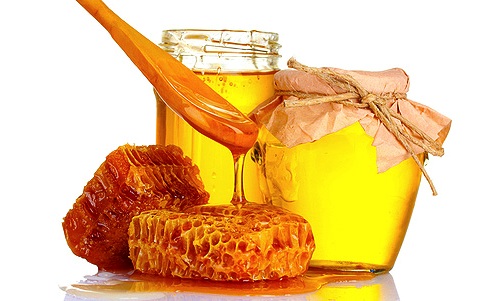
Honey is a sweet food made by bees using nectar from flowers. The variety produced by honey bees (the genus Apis) is the one most commonly referred to, as it is the type of honey collected by most beekeepers and consumed by people. Honeys produced by other bees (bumblebees, stingless bees) and other hymenoptera insects (e. g. honey wasps) have different properties, and they are not discussed in this article.
Honey bees transform nectar into honey by a process of regurgitation and evaporation. They store it as a primary food source in wax honeycombs inside the beehive.
Honey gets its sweetness from the monosaccharides fructose and glucose, and has approximately the same relative sweetness as granulated sugar. It has attractive chemical properties for baking and a distinctive flavor that leads some people to prefer it over sugar and other sweeteners. Most microorganisms do not grow in honey because of its low water activity of 0.6. However, honey sometimes contains dormant endospores of the bacterium Clostridium botulinum, which can be dangerous to infants, as the endospores can transform into toxin-producing bacteria in infants' immature intestinal tracts, leading to illness and even death.
Honey has had a long history in human consumption, and is used in various foods and beverages as a sweetener and flavoring. It also has a role in religion and symbolism. Flavors of honey vary based on the nectar source, and various types and grades of honey are available. It has also been used in various medicinal traditions to treat ailments. The study of pollens and spores in honey (melissopalynology) can determine floral sources of honey. Bees carry an electrostatic charge whereby they attract other particles in addition to pollen, which become incorporated into their honey; honey can be analysed by the technique of melissopalynology, in the area of environmental studies of radioactive particles, dust and particulate pollution.
Posted on Saturday, September 13, 2014 by Benitez Fidel Martin
Subscribe to:
Posts (Atom)
Popular Posts
-
Honey Honey is a sweet food made by bees using nectar from flowers. The variety produced by honey bees (the genus Apis) is the one mos...


